
Trying to find the best tube amp tone from a solid-state amp was always a tough mission. Until now. The Laney IRONHEART Foundry series takes everything we love about the sound, touch and feel of a traditional valve amplifier and puts it into an all-analogue, solid-state design that compromises absolutely nothing on tone. But which IRONHEART Foundry amp should you choose for home, studio or live performances?
Today I’m going to help you compare each of the Laney Ironheart Foundry series amplifiers in a complete buyer’s guide. I’ve already covered the complete Laney Ironheart amp comparison guide, but today, I’m drilling down on the Foundry series to discuss their benefits and which amp might be best for you.
Let’s be honest here, when it comes to the differences between solid state vs tube amps there’s something special about playing through a great valve amp. The way it responds to your picking dynamics, how it cleans up when you roll back your guitar’s volume, and how the gain gets progressively more aggressive the harder you drive it. It’s not JUST about the sound. It’s about how the amp feels underneath your fingers.
This is what the incredible team at Laney set out to achieve with the Laney IRONHEART Foundry series.
Tone wizard Simon Fraser-Clark at Laney says” We know how a great valve amp should sound, but more importantly, we know how it should FEEL. So, rather than simply making another solid-state amplifier with a high-gain distortion circuit, we took the circuit topology and tonal characteristics of our IRONHEART tube amplifiers and re-engineered them into a solid-state platform designed to behave and interact like the real thing. “
So what you get is all the touch, feel and response you expect from a valve amp, without needing valves to achieve it – or being able to bench press 150kg every time you want to move it around (I joke…but valve amps are heavy!).
And because these are IRONHEART amps, you can expect everything from clean tones to the aggressive, articulate, high-gain sounds that have made the series so popular with metal and hard rock guitarists. They provide, as Simon likes tos ay, “ everything you need. Nothing you don’t.”
It’s hard to choose the best Ironheart Foundry amp if you don’t know much about them…so in this guide, I’ll walk you through the four different IRONHEART Foundry amplifiers and explain why they’re the best solid-state amps for tube tone and feel, what makes their analogue circuitry different from conventional solid-state amplifiers and break down which model might be right for your playing.
We’ll look at the 60-watt IRF60-110 and IRF60-112 combos, the flagship 120-watt IRF120-212 combo, and the IRF120H amplifier head. I’ll also cover the IRF112 and IRF212 speaker cabinets for those who want that head-and-cab setup that just looks awesome on stage.
Along the way, we’ll explain the benefits of features such as footswitchable pre-boost, the passive EQ sections, LA·IR speaker cabinet emulation, USB recording and low-power modes, because knowing what a feature actually DOES for your playing is far more useful than simply reading a list of specifications.
One of the biggest differences between valve and solid-state guitar amplifiers has traditionally been the way they respond to how we play guitar.
Valve amps are known for their dynamic response, which means when you pick or play gently, your tone remains relatively clean. But when you dig in harder when you play, the amp responds with additional drive, compression and sustain. If you roll back your guitar’s volume when playing through a valve amp or tube amp, you can clean up an overdriven sound without necessarily touching the amplifier- solid-state amps haven’t quite nailed that feature yet.
Until now. This is why we think the Ironheart Foundry series amps give you the best tube amp tone from a solid-state amp. We think we’ve nailed it.
The IRONHEART Foundry series uses analogue solid-state circuitry designed to recreate the behaviour and tonal response of our IRONHEART valve amplifiers, rather than simply producing a distorted sound that resembles the pleasing distortion of a tube amp.
That means the amplifier responds to how you play. Back things off, and the sound cleans up. Push harder, increase the gain or engage the pre-boost, and you can move into the aggressive high-gain territory that IRONHEART is known for.
This is important because the best guitar amps don’t just give you a great sound when everything is turned up; they react to how you play first and foremost, because THAT is where the feel and emotion comes through on your sound.
Before we look at each amplifier individually, let’s cover some of the features that make these amps so versatile.
At the heart of the IRONHEART Foundry series is an analogue signal path based on the circuit topology and characteristics of our IRONHEART tube amplifiers.
Rather than relying on digital amp modelling to generate the core amplifier tone, we’ve designed the analogue circuitry to deliver the response and gain characteristics players expect from the IRONHEART series.
We’ve also added features such as digital reverb and our LA·IR cabinet emulation.
One of the defining features of the IRONHEART family is its pre-boost functionality, and we’ve carried that philosophy into the Foundry range.
The pre-boost allows you to push the front end of the amplifier harder, increasing the amount of drive available without having to completely change your existing settings.
For example, you might have a great crunchy rhythm tone dialled in, but need additional saturation for a solo or a particularly aggressive riff. Engage the pre-boost, adjust its level, and you can push the amplifier further into high-gain territory.
Metal guitarists will love this as it’s a really useful feature because you have another way to shape the gain structure rather than simply turning everything up to ten and getting evicted.
Pre-boost is included on the IRF60-110, IRF120-212 and IRF120H.
Tone shaping is incredibly important when you’re playing high-gain guitar, particularly if you want clarity and definition when playing fast riffs or heavily distorted chords.
The Foundry amplifiers feature passive three-band EQ controls for adjusting your bass, middle and treble frequencies.
Depending on the model, you also have additional gain characteristics and Bright, Flat and Dark voicing options. These allow you to change the overall character of your sound before making more detailed EQ adjustments. Want a brighter, more cutting sound? You’ve got options. Prefer something darker and heavier? You can dial in your sound the way you want.
The 120-watt IRF120-212 also features independent three-band EQ controls for both channels, which is particularly useful when switching between clean and distorted sounds during a live performance.
You don’t always need to be playing at full stage volume. In fact, most of us spend far more time practising at home than playing in front of a few thousand people!
That’s why the Foundry amplifiers feature high and low power modes.
Depending on which Ironheart Foundry amp you choose, you can enjoy the full 60 or 120 watts of output, or switch down to a low-power mode rated at less than 1 watt for bedroom practice but still get those high gain tones and dynamics. This means you don’t need a separate practice rig at home. This works perfectly. Want to work on your riffs at home without waking the neighbours or blowing out your windows? Use low-power mode. Need more output for rehearsals or gigs? Switch back to full power and you’re good to go.
For guitarists who record at home or want to send their amplifier directly to a PA system, our Laney Advanced Impulse Response technology, or LA·IR, is a particularly useful feature.
Available on the IRF60-112, IRF120-212 and IRF120H, LA·IR provides digital impulse-response-based speaker cabinet emulation through a balanced XLR output.
Why is that important? Well, a guitar speaker cabinet has a huge influence on the final sound of an amplifier. If you’ve ever connected an amplifier’s unprocessed output directly to your DAW, you’ll know that the sound can be quite different from what you hear through a guitar speaker.
We solved that by placing cabinet emulation in the amps which helps recreate that speaker response when you’re recording or connecting directly to a PA. We’ve also included USB-C audio connectivity on these models, so you can integrate the amplifier into your recording setup without needing to mic up a speaker cabinet.
Ok let’s compare the actual amps.
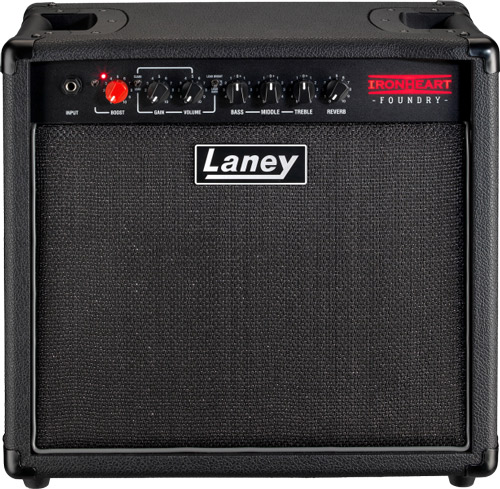
If you want the IRONHEART sound and valve-like response in a compact, straightforward combo amplifier, the Laney IRF60-110 is a great place to start.
This 60-watt all-analogue solid-state combo is equipped with a custom-voiced 10-inch HH H1060-8 loudspeaker, delivering the familiar IRONHEART gain character in a smaller, more portable package.
But don’t let the speaker size fool you. You’ve still got 60 watts RMS to work with, which makes this far more than simply a bedroom practice amp as you can definitely hit gigs with this.
The IRF60-110 features two independent channels: a Clean channel with its own volume control and a Lead channel with gain and volume controls. On the Lead channel, we’ve included switchable Bright, Flat and Dark voicings, giving you options for adjusting the overall character of your distortion before you start fine-tuning the sound using the three-band passive EQ. For example, you might prefer a brighter voicing for riffs that need additional definition, or something darker when you’re after a heavier, thicker sound.
We’ve also included a built-in footswitchable pre-boost with adjustable level, allowing you to push the amp harder when you need extra gain. This is where the IRONHEART design philosophy really gets useful as you don’t just have a fixed distortion sound, the analogue circuitry is designed to respond dynamically to your guitar and playing style so it responds to how you play giving you the best tube amp tone from a solid-state amp.
There’s also digital reverb with footswitchable control, so you can add some space to your cleans or lead sounds without needing an external reverb pedal and for those of us who love using pedals, we’ve included a 6.3mm effects loop so you can hook up your delay and modulation. The FX Send can also double as a line output.
You’ve also got a 3.5mm auxiliary input for playing along with backing tracks and a headphone output for quieter practice sessions.
And because the IRF60-110 includes both 60-watt and less-than-1-watt power modes, it’s equally at home when you’re practising riffs in the bedroom or need the additional power for rehearsals and gigs.
In a nutshell, if you want a compact, powerful analogue guitar combo with the signature IRONHEART gain character, without needing extensive recording features, the IRF60-110 should be on your “must-try” list.
Best For:
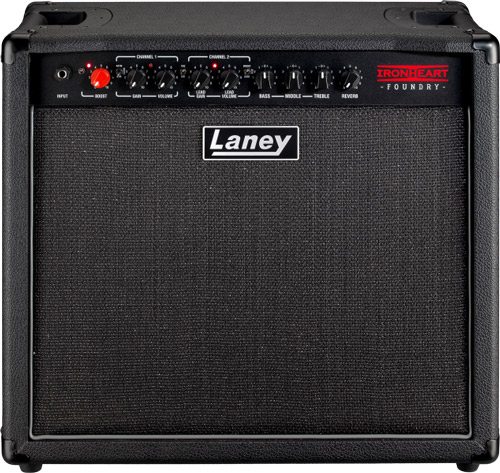
Ok, we’re keeping the same 60 watts here, but we’re increasing the speaker size and adding some serious recording functionality.
The Laney Ironheart Foundry IRF60-112 is a 60-watt, two-channel analogue solid-state combo fitted with a custom HH H1260 12-inch speaker.
So why would you want to upgrade from the IRF60-110 to the IRF60-112 in terms of speaker size?
First, you’ve got a larger 12-inch speaker, which can give you a different sense of fullness that you just feel when you play. There’s more projection and low-frequency response compared with a 10-inch speaker, which is why choosing a speaker cabinet is so important and why the speaker cabinet makes such a difference. Of course, the speaker design and cabinet construction also contribute to the overall sound, but it’s something to think about when choosing your guitar amp.
Next, the IRF60-112 brings additional flexibility for guitarists who want to record their music or connect directly to a PA. We’ve equipped this model with two independent channels, footswitchable channel selection and additional gain character options, including ASYM, Clean and SYM settings, alongside Bright, Flat and Dark voicings.
These give you a wide range of sounds to work with, whether you’re after cleaner tones, classic crunch or modern high-gain distortion. You’ve also got a three-band passive tone stack, so you can fine-tune the bass, middle and treble to suit your guitar, pickups and playing style. And again, the analogue design is all about how the amplifier reacts to YOU.
The Laney Ironheart Foundry IRF60-112 delivers some of the best tube amp tones from a solid-state amp, combining that responsive analogue feel with modern features that make recording and performing considerably easier.
The biggest difference between the IRF60-112 (this one) and the Laney IRF60-110 is that this has LA·IR technology. The IRF60-112 also features a balanced XLR direct output with selectable impulse-response cabinet emulation and a ground lift switch. This means you can send your guitar sound directly to a recording interface or PA system while using digital cabinet emulation to recreate the tonal effect of a guitar speaker that actuakly sounds good.
We’ve also included USB-C audio input and output, along with connectivity for the LA·IR app and updates so you can also include your amp into your recording workflow.
The headphone output also features cabinet emulation, making it particularly useful when you’re practising quietly but still want a more complete guitar sound through your headphones. There’s an effects loop, with the FX Send doubling as a non-emulated line output, an auxiliary input for backing tracks and digital reverb with level and footswitchable control.
Finally, high and low power modes allow you to switch between the full 60 watts RMS and less than 1 watt for home use.
What I particularly like about the IRF60-112 is that it is a fully ready-to-gig amp that you can use to record with.
Best For:
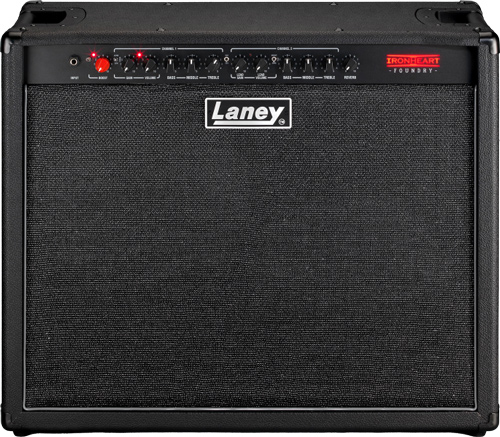
Ok, now we’re getting into the BIG stuff.
The Laney Ironheart Foundry IRF120-212 is the flagship combo in the IRONHEART Foundry series, delivering 120 watts RMS through two custom-designed 12-inch HH H1260 speakers in an offset 2×12 configuration.
So we’re doubling the power compared with the 60-watt combos, adding another speaker and giving you some additional flexibility over your tone.
This is a seriously capable amplifier for guitarists who want a powerful all-in-one rig for rehearsals, live performances and recording.
Let’s start with the 2×12 speaker configuration and why you should care.
Compared with a single-speaker combo, a 2×12 setup gives you more speaker area, which can change the overall projection, low-end character and sense of fullness when playing at volume.
For heavy guitar tones, particularly where you want powerful palm-muted riffs and plenty of stage presence, that can be a real advantage. The IRF120-212 features two fully independent channels, each with its own three-band passive tone stack. Now, THIS is particularly useful as rather than sharing one set of EQ controls between your clean and distorted sounds, you can adjust the tonal balance of each channel independently. For example, you might want a bright, clear clean sound with plenty of top-end detail, but prefer to dial back certain frequencies and adjust the mids when switching to a heavily distorted rhythm tone. With independent EQ, you’re not forced to compromise between those settings.
We’ve also included selectable ASYM, Clean and SYM gain characteristics, Bright, Flat and Dark voicings, and a built-in footswitchable pre-boost with level control.
So, whether you’re playing tight modern metal riffs, classic hard rock or something that needs a little less gain, you’ve got plenty of options for shaping the sound.
Best tube amp tone from a solid-state amp? The IRF120-212 takes the Foundry approach to its most powerful combo format, combining responsive analogue circuitry with the output and speaker configuration needed for demanding live environments where you need a bigger, fuller sound onstage.
“One of the things we wanted to preserve was the way an amplifier responds when you change your playing dynamics or roll back the volume on your guitar. Having 120 watts available doesn’t mean you have to play at maximum gain or volume all the time. You can still use the clean and lower-gain characteristics of the amplifier and let your playing control how the sound develops.” Says Simon
Again, for recording and live connectivity, the IRF120-212 features LA·IR digital cabinet emulation through a balanced XLR output, complete with selectable IR and ground lift. You also get USB-C audio I/O, connectivity for the LA·IR app, a cabinet-emulated headphone output and a 6.3mm effects loop. We’ve included digital reverb with adjustable level and footswitchable control, plus an auxiliary input for playing along with backing tracks and of course you can still switch the amplifier into a low-power mode rated at less than 1 watt. So yes, you can have a powerful 2×12 amplifier designed for demanding live performances and still use it at home without needing to run it at full output.
The IRF120-212 is a great choice for guitarists who want a full-featured, high-gain amplifier in one combo, particularly if you don’t want to carry a separate head and speaker cabinet.
Best For:
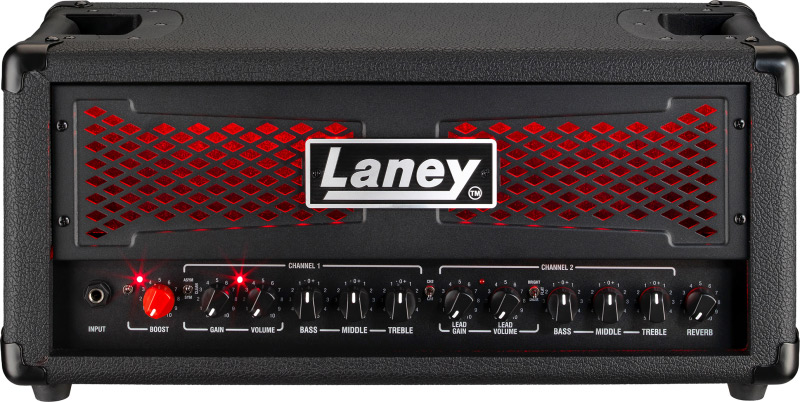
Not everyone wants a combo amplifier. Some of us prefer the traditional head-and-cabinet setup, whether that’s because we want to choose our own speaker configuration, use different cabinets for different venues or simply enjoy having a big amp head sitting on top of a cabinet!
If that’s you, the Laney Ironheart Foundry IRF120H amplifier head is the Foundry amplifier to look at.
This 120-watt all-analogue solid-state head delivers the IRONHEART Foundry feature set in a standalone amplifier format, ready to pair with a suitable guitar speaker cabinet.
As with the IRF120-212 combo, you’ve got two independent channels, selectable gain characteristics, Bright, Flat and Dark voicings, three-band EQ and a built-in footswitchable pre-boost with level control.
The important thing here is that you’re getting the same Foundry design philosophy, built around the sound and response of our IRONHEART valve amplifiers, but with the freedom to choose your speaker cabinet. And remember, the speaker cabinet plays a huge part in your overall guitar tone.
You might prefer a compact 1×12 cabinet for smaller rehearsals and easier transport, or a 2×12 setup when you want additional projection and a bigger onstage sound. With a separate amplifier head, you have the flexibility to build the setup that works for you, provided you’re using a cabinet with the appropriate impedance and power handling.
If you want the best tube amp tone from a solid-state amp? The IRF120H gives guitarists who prefer traditional head-and-cabinet rigs access to the responsive IRONHEART Foundry analogue circuitry, without committing to a built-in speaker configuration. For live performances, we’ve included twin 6.3mm loudspeaker outputs, a balanced XLR direct output with LA·IR cabinet emulation and a ground lift switch. This gives you the option to run a traditional speaker cabinet onstage while also sending an emulated signal to a PA system or recording interface.
The IRF120H also features USB-C audio I/O and LA·IR app connectivity, making it just as useful for recording guitar parts as it is for rehearsals and live performances and again there’s a 6.3mm effects loop, with the FX Send doubling as a non-emulated line output, digital reverb with level and footswitchable control, and a cabinet-emulated headphone output as well as an auxiliary input for playing along with backing tracks.
And just like the 120-watt combo, you can switch from the full 120-watt output to a low-power mode rated at less than 1 watt so you don’t have to choose between having a powerful gigging head and something you can use for lower-volume practice.
For guitarists who enjoy building their own rigs, the IRF120H is probably the most flexible option in the series here, so go for that.
Best For:
If you’ve decided that the IRF120H is the amplifier for you, the next question is which speaker cabinet should you pair it with?
We’ve designed two matching Foundry cabinets: the IRF112 and IRF212. Both feature custom-designed HH speakers, robust all-wood construction, heavy-duty carrying handles, hard-wearing vinyl finishes and stainless steel metal corners.
So, whichever you choose, they’re designed to handle the practical demands of rehearsals, transport and live performances.
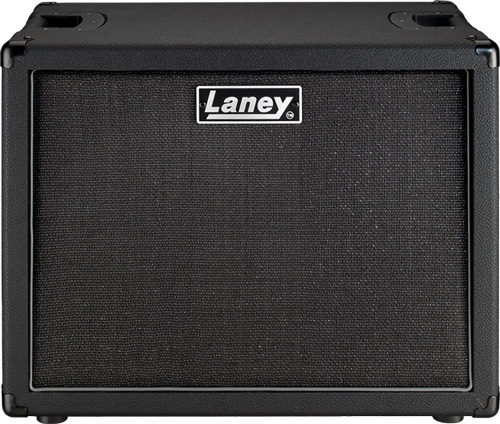
The Laney Ironheart Foundry IRF112 speaker cabinet is a compact 1×12 guitar speaker cabinet fitted with a custom-designed HH H1260-8 driver designed to pair with the IRF120H.
It’s an 8-ohm cabinet designed to provide strong projection and guitar tone in a practical, portable format. If you’re regularly travelling between rehearsals, recording sessions and gigs, a smaller cabinet is generally easier to transport and position than a larger multi-speaker setup. The IRF112 features an all-wood enclosure, side-mounted heavy-duty handles, hard-wearing vinyl and stainless steel corners, so it has the practical construction you’d expect from a gigging cabinet.
Best For:
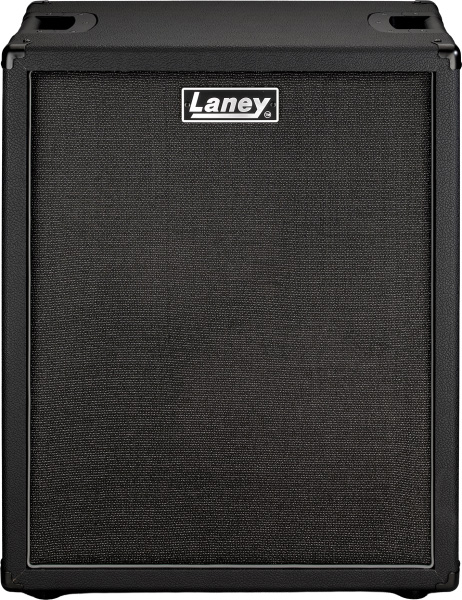
If you want something bigger, the Laney Ironheart Foundry IRF212 speaker cabinet doubles the speaker count with two custom-designed HH H1260-16 12-inch drivers.
The cabinet is rated at 8 ohms, with specifications of 120 watts RMS, 240 watts continuous and 480 watts peak. A 2×12 cabinet gives you more speaker area, which can influence the way the sound projects and how full the guitar feels in the room.
For guitarists playing heavy riffs or performing alongside a loud drummer and bass player, that’s certainly worth considering.
The IRF212 uses robust all-wood construction and includes heavy-duty side handles, protective stainless steel corners and a hard-wearing vinyl finish and at 21.2kg, it’s a substantial cabinet, but still offers a practical alternative to larger multi-speaker rigs, so you’ll be able to lift it pretty easily.
Obviously, this is designed to pair with the IRF120H, which then gives you a traditional 120-watt head-and-2×12 setup with the tonal flexibility, recording connectivity and analogue IRONHEART response I’ve been talking about, just in that head and cab combo style you might want.
Best For:
The IRF60-110 is the most straightforward amp in the range. You get 60 watts, a 10-inch HH speaker, two channels, footswitchable pre-boost, three-band EQ and digital reverb. Unlike the other models, it doesn’t have LA·IR cabinet emulation, USB-C recording or an XLR DI output. This is the amp for guitarists who want the Ironheart sound and feel without all the additional recording technology.
The IRF60-112 keeps the same 60 watts but upgrades to a larger 12-inch speaker. More importantly, it introduces LA·IR cabinet emulation, an XLR DI output, USB-C recording and additional gain-character options that the IRF60-110 doesn’t have. This means you can connect directly to a PA system or recording setup without having to mic up the amplifier. It’s the biggest jump in functionality within the range, taking the basic 60-watt combo and turning it into a much more versatile recording and gigging amplifier.
The IRF120-212 takes the advanced features of the IRF60-112 and doubles the output to 120 watts, with two 12-inch HH speakers instead of one. But the most important difference, aside from the additional power and speaker, is independent three-band EQ for each channel. This means you can set up completely different EQ settings for your clean and distorted sounds without compromising either. It also explicitly includes a footswitchable pre-boost. This is the flagship combo for players who want greater stage presence, power and control over their sound.
The IRF120H delivers 120 watts and the advanced features of the Foundry range, including LA·IR, USB-C recording, XLR DI, pre-boost and selectable gain voicings. The major difference is that it’s an amplifier head rather than a combo, so there are no built-in speakers. Instead, you have twin speaker outputs and can pair it with the IRF112, IRF212 or another suitable cabinet. This gives you the flexibility to change your speaker configuration depending on whether you’re practising, recording or performing live.
Yes they are, especially if you choose one of the models equipped with LA·IR and USB-C audio connectivity.
The IRF60-112, IRF120-212 and IRF120H are particularly useful for home recording because they give you ways to capture guitar without having to rely exclusively on microphone placement and a loud speaker cabinet. The balanced XLR outputs with cabinet emulation allow you to send a processed guitar signal to your recording equipment, while USB-C audio I/O provides another way to integrate the amplifier into your digital recording workflow.And don’t forget the low-power settings as they are able to reduce the amplifier’s output to less than 1 watt which means you can practise and work on sounds at considerably lower volumes.
Demos, home practice, home recording – you’re covered.
Well, they’re IRONHEART amps, so you probably know the answer to this one! The original IRONHEART series became known for aggressive high-gain sounds, responsive gain structures and the ability to deliver clarity when playing heavily distorted guitar, and they were embraced by metal players all over the world. We’ve carried that philosophy into the Foundry series. You can dial in cleaner tones, crunchy rhythm sounds or push into more saturated distortion using the available gain controls, channel voicings and pre-boost features.
If you’re a heavy metal, hard rock or thrash player, the dynamic response is particularly important as you don’t just want an amplifier that produces huge amounts of distortion – you want something that reacts to your picking, preserves definition in fast riffs and gives you control over the gain structure.
Watch the team at Andertons bust out some riffs on these amps and hear them for yourself…
So, we’ve covered all four amplifiers and the matching speaker cabinets, but which one should you actually choose?
Here’s how I’d break it down if you asked me which is the best Laney Ironheart Foundry amp for different uses.
| Your main priority | My recommendation |
| Compact home practice and rehearsals | IRF60-110 |
| A 60W combo for recording and gigs | IRF60-112 |
| A powerful all-in-one metal amp | IRF120-212 |
| A traditional head-and-cabinet setup | IRF120H |
| A smaller, more portable cabinet | IRF112 |
| A larger speaker setup for live performance | IRF212 |
As our resident tone wizard, Simon Fraser Clark always says: “The golden rule is, there are no rules”, so of course, you can use the 120-watt amplifiers at home in low-power mode, and the 60-watt combos have more than enough power for rehearsals and live performances. Just choose the amp you want based on how you play and how much power you think you’ll need.
When we set out to create the IRONHEART Foundry series, we wanted to preserve the things that make a great valve amp so enjoyable to play and make an amp that gives you the best tube amp tone from a solid-state amp.
The way the gain responds to your picking, the way the sound cleans up when you roll back your guitar’s volume, and the way the amp becomes more aggressive the harder you push it and dig in on your playing. And we’ve combined that approach with practical features such as high and low power modes, flexible tone shaping, effects loops and, on selected models, LA·IR cabinet emulation and USB-C connectivity.
So whether you’re practising in the bedroom, recording your next release or playing live with a loud metal band, there’s an IRONHEART Foundry amplifier designed to fit your setup. The Laney IRONHEART Foundry series of solid-state amps gives you “Everything you need. Nothing you don’t.”
Explore the complete Laney IRONHEART amplifier range and find the Foundry amp that works for you.